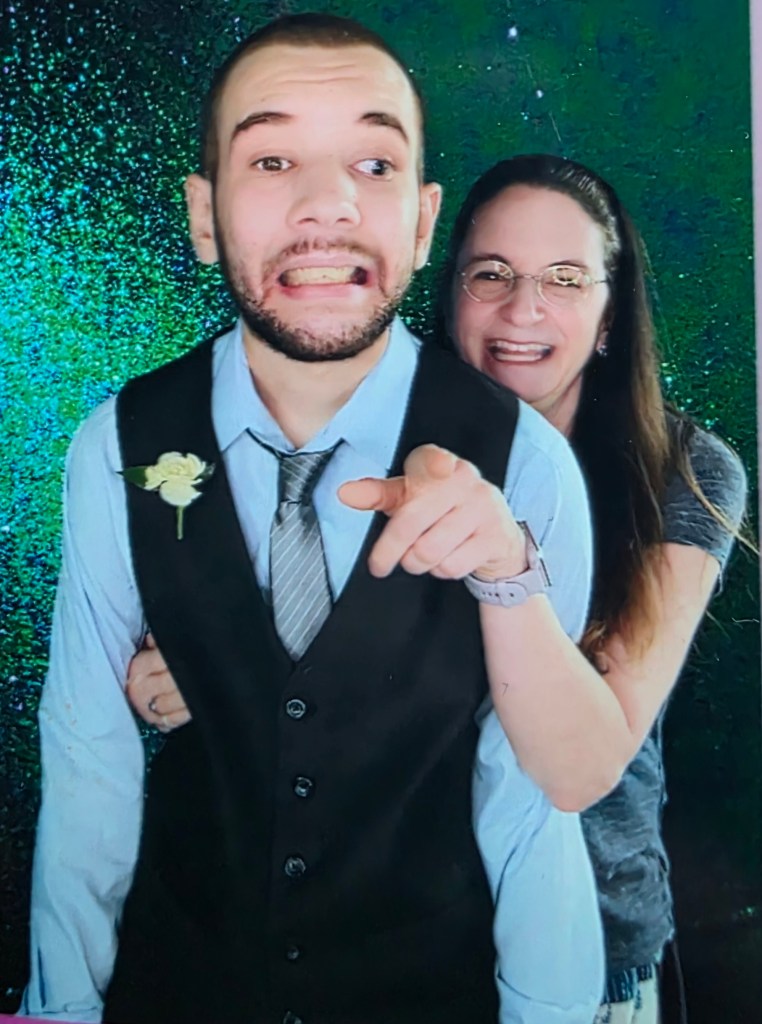

Two years ago Jonah and I attended the Anderson prom, which I thought would be his only prom – but when they told me it was actually a biennial event, I was excited to go again and be Boo’s “date.” He and his peeps got to ride in a party bus to the decorated recreation center pavilion, where a DJ spun tunes and everyone celebrated together. He’s more walker than dancer, so we mostly promenaded in and around the dance floor, hand (and Gatorade) in hand. They served buffet dinner after a while and I was kind of amazed at how well everyone waited in line for their food. Even Boo!
Maybe the best part about the prom was the camaraderie and understanding among the families and friends attending. At any given time, one of the students might lie on the ground, screech, run in circles, remove clothing, clutch the DJ’s arm, etc. Really anything that might be embarrassing or inappropriate at a regular prom was fair game here. Yet no one endured stares or judgement in this very safe space, because we’re all in this together.
I’m so grateful to Briana and everyone at Anderson who helped plan, decorate, serve, supervise, and work hard so these youngsters could participate in a “normal” school activity.
I’m even more grateful now that we are nearing the end of Jonah’s time at Anderson, for many of the privileges he enjoys there will also end once he leaves. For the last 14 years, he’s lived in a 100+ acre gated campus environment with a school right on the grounds. He’s got access to an inground pool, recreation center with adaptive play equipment, a school/day program, all kinds of activities, and a house full of people who already know and love him. He has dozens of sets of eyes on him every day to ensure his safety and well being. He enjoys events on campus like the prom, easter egg hunts, trick-or-treating, Christmas tree lighting, and other seasonal celebrations. He gets to participate in outings like autism walks, trips to the Dutchess County fair, and a day at the waterpark. When he goes for a walk on campus, staff with him have walkie talkies and can call for quick help/backup if Jonah has an aggressive episode.
After Anderson, he’ll have very little of what he has there and there’s nothing I can do about that. There are few campus-like environments for adults. The only one I know about is in Sullivan County, even further away from his father and me than he is now. If I had the money, I’d build one right here in the Capital District and oversee its construction, staffing, and operation. It would have the best of everything, of course.
I thought we could fly under the radar forever at Anderson, but we can’t. So Boo will be living in a supervised IRA (individualized residential alternative), a traditional family-style group home with 24-hour staff support and supervision. There’s one in Ballston Spa (which is about an hour closer than Anderson) and OPWDD has officially offered us placement.
Do we take it? Is there a better option? What happens if we say no?
Normally I could at least tour the house and talk to staff. I could get a read on the well-being and happiness of the residents. I could find out what their schedule is like and what kind of day program is available. I could talk to the parents/loved ones of individuals who already live there and ask pointed questions. But this house is empty. The previous residents, I’m told, had ambulatory needs that couldn’t be met there, so they were moved out. The house has been vacant since December. That means I can’t tour anything but an empty space and I can’t rely on anyone’s story or lived experience.
I went into panic mode: I am suddenly on an episode of Let’s Make a Deal and Monty Hall himself is offering three curtains, behind each of which is a prize. First I’m offered a dining room set. Then I have the choice of keeping it or trying one of the other two curtains. Behind one of the other curtains is a Cadillac; behind the other is an elderly goat chewing on a bale of hay. My choice is final.
Is this IRA the dining room set or the Cadillac? Could it be the goat? How to choose? After all, it’s not a game show. It’s Jonah’s future. Barring a major problem, he will live there for the rest of his life. How can we have so little information with which to move forward?
First, I emailed any person, place, or organization I could think of who might be able to offer guidance. I heard lots of things. More than once I was told there are thousands of individuals awaiting placements like the one we’ve been offered, and people wait for years in situations far less comfortable than Anderson. Some end up living in the hospital because they have nowhere to go. We were advised to take the placement.
I requested a zoom meeting during which I could ask questions, and Andy came up with other questions I didn’t think of. I asked Briana and her supervisor from Anderson to be there too. During the meeting, someone from the IRA team was at the house and showed video by walking around with their phone, pointing out the living areas and bedrooms. Aside from a dedicated office space on the basement floor, by all appearances it is a normal looking house on a 30-mph road with sidewalks in a neighborhood. It does not have a pool, or a backyard to speak of (the back is a paved area for cars). There’s a small patch of woods between the house and the one behind it. A wrought-iron fence forms a short path area in the front that appears to have a locked gate, with enough room for some small porch furniture.
I asked how many people would be living there, and what’s the ratio of staff to residents, and how they’re trained, and how visitations work, and how transitioning from Anderson to the new house will work, and how he’ll get his medications and go to the doctor and eat food he enjoys, and how he’ll be able to go for a walk or to the local park or to the town pool – and a whole host of other things. I held back tears that threatened to come every time I opened my mouth to speak. I held back the weeping, the screaming, the pleading demanding convincing insisting arguing…I held it all back and I forced myself to breathe and I forced myself to stay calm. I told them no matter how many questions I was allowed to ask, there would always be more questions. They assured me I could ask them all, that there would be many more meetings, that this would not be like ripping off a band aid but rather a slow and deliberate process. They really did try to be reassuring and kind. They really did seem to understand my worries and concerns.
The last thing I asked was how quickly we needed to make the decision. The answer was not immediately but soon. And so we decided to take the placement. Just this morning, in what felt like a monumental act, I sent an email to the representative at OPWDD telling her this. She emailed back almost immediately:
That’s great news! I was going to send you a list of people on Jonah’s team today. Also, there will be more meetings. Thanks so much for your help and patience. I know that the process can be difficult.
The process is difficult indeed, already, somehow – and nothing’s even happened yet.
I think of Guster’s song Come Downstairs and Say Hello and its wonderful instruction:
Be calm. Be brave. It’ll be OK.
It will be OK, because I need to believe it in a way I’ve never needed to believe anything before, if you don’t count August 16, 2011, the day he left our home to live at Anderson.
I’m planning to ask a lot more questions (and please feel free to say what you would ask). I’ll research the community and its programs and services for people with disabilities. I’ll contact the local fire and police departments to ask about emergency preparedness plans for his house. I’ll tell OPWDD to give my contact information to all the other families of people who’ll be living there, since I can’t legally ask for theirs. I’ll paint his room an ocean blue and stick glow-in-the-dark constellations on his ceiling.
I’ll see if I can win him that Cadillac.
 The Never Normal